
About Kalpathy Kasi Temple

Dakshina Kasi
The temple at Kalpathy is often referred to as Dakshina Kashi by devotees in and around Kerala.
The temple is revered and embraced by all four Agraharams, traditional Brahmin settlements, that flank it. New Kalpathy, Old Kalpathy, Chathapuram, and Govindarajapuram—each echo centuries of faith, devotion, culture, and spiritual harmony in unison around this sacred site.
Today, around four lakh people throng the gates of these Agraharams to participate prayerfully during the chariot festival of Sree Visalakshi Sametha Sree Viswanatha Swamy. The divine Shiva–Parvathi couple is celebrated with traditional ancient music, dance, chants, and vibrant festivity, echoing the collective faith and fervor carried by the Nila River across Kerala, eternally flowing since the building of the temple.
Sthalapuranam (History) of Viswanatha Swamy from Kasi To Kal

In the late 1300s, Lakshmi Ammal and her co-sister, Mangala Ammal, lived with their respective husbands in Chandrasekharapuram, one of the earliest 18 agraharams of Tamil Brahmins who migrated to Palghat from Tanjavur, Tamil Nadu. They were wealthy but had no heirs to inherit their vast estate.
In their late middle age, they left their roots and decided to travel as pilgrims to Kashi to spend their final years at the feet of Lord Vishwanatha, on the sacred banks of the Ganges. With the passage of time, and following the demise of their husbands, their Guru gifted them a sacred Bana Lingam. At the behest of the Guru, who urged them to return to their roots and establish a home for the sacred stone, the two aged widows undertook a historic journey back to Palghat.
Their journey from Kasi was undertaken entirely on foot. After crossing the Ganges, the Vindhyachal mountain range, and then the Narmada River, they traversed the Deccan Plateau. They went on to cross the sacred Godavari and Krishna Rivers and entered through the Palakkad Gap. This arduous journey took over six months.
Original Temple
Public and institutional records consistently attest that Lakshmi Ammal offered a consecrated endowment of 1,320 gold coins to the Raja of Palakkad. This offering is supported by authoritative temple records, royal acknowledgments, and revenue documents that recognize both the acceptance of the gold coins and the assumption of responsibility for administering the temple and its affairs by the Raja. The foundation stone was laid to begin construction in 1425, with the blessings of Lakshmi Ammal, Mangala Ammal, and Raja Ittilkombi Achan. This marked a historic moment in the annals of Indian temple history, where two widowed women (praja) and the ruler (prajapalak) of the region came together to express their gratitude to the sacred divine in building this temple. Six hundred years later, the temple continues to thrive with the support of the Raja family and the people of the Kalpathy Agraharams, now a UNESCO World Heritage Centre, and beyond.
The sworn accounts of Sri Somasundara Gurukkal, who served as the temple priest at that time, affirmed that the Raja Ittilkombi Achan, honoring this sacred duty, entrusted the management of the temple to his descendants of the Valia Konikkal Madam. The King also bestowed lands for the sustenance and preservation of the temple. These lands were sanctified as inam, or revenue-free holdings—a status that was reverently upheld by successive rulers, including Tipu Sultan and later the British Government—allowing the temple’s sacred legacy to endure across generations.

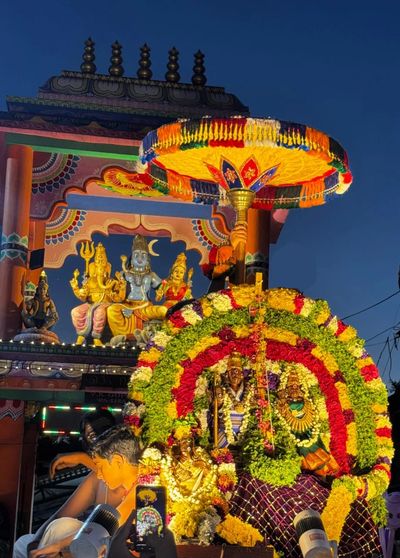
The Temple in 2026
Even today, the management of the temple remains in the hands of the Trustee, a descendant of the erstwhile princely family. In more recent times, land reforms have divested the temple of the income once derived from these lands. At present, the temple is sustained through the heartfelt offerings of devotees and vazhipadu collections, a living testament to their enduring faith.
The first face of the inscription engraved on the granite slab before the temple, records the details of the lands gifted to the temple, along with their four boundaries. The Agraharam sites of the four streets—Old Kalpathy, New Kalpathy, Chathapuram, and Govindarajapuram—are all encompassed within the boundaries of the lands bestowed, as described in the stone inscription. This clearly affirms that the Brahmin houses of the four Agraharams were already in existence at the time of the grant recorded on the sacred stone.
Maha Kumbhabhisheka Mahayagnam (May 25, 2026)
Prayers offered for the Anugraha of Sree Visalakshi Sametha Sree Viswanatha Swamy and seeking the Ashirvadams of Jagadguru Adisankara Bhagavatpada Moolamnaya Sarvajna Peetam Sree Kanchi Kamakoti Peetam and Mahasamsthana Dakshinamnaya Sree Sringeri Sarada Peetam.
With immense happiness, we invite all devotees to participate in the Maha Kumbhabhisheka Mahayagnam at Sree Vislakshi Sametha Sree Viswanatha Swamy Temple, Kalpathy, Palakkad to be performed on 25th May 2026.
Maha Kumbhabhishekam was conducted in the recent past in 1956, 1981 and 2008. Now after 18 years, the Maha Kumbhabhishekam is to be conducted at Sree Vislakshi Sametha Sree Viswanatha Swamy Temple and Upadevataas, Sree Mahaganapathi, Sree Valli-Devasena Sametha Sree Subramania Swamy, Sree Dakshinamoorthy, Sree Gangadhara, Sree Kalabhairava, Sree Chandikeswara, Sree Sivasooryamoorthi, Sree Nandhikeshwara and Navagraha Devatas.
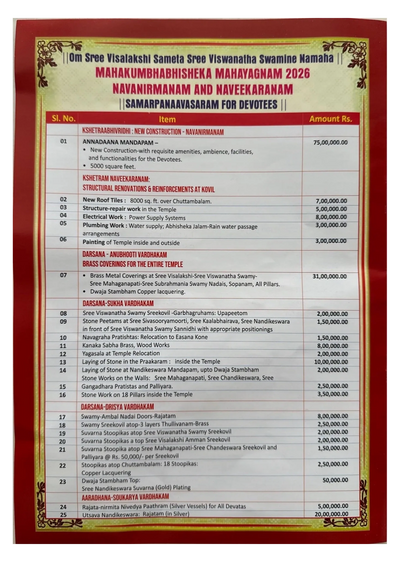
Sacred Rituals and Renovations
(A temple flourishes with the following five - Penance of the Acharya, Veda Japam, Nitya Pujas, Utsavam, Annadaanam, says Sastra)
Japams, Homams and Archanas as per Vedic and Agamic Sastras will be performed during this Mahakumbhabhisheka Mahayagnam by learned Sivacharyas and Vedic Scholars aimed at further enhancing Bhagavat-Chaitanya.
The occasion will serve Dharma - Pracharanam, Purana Katha - Pravachanam, Naama - sankeerthanam etc. Requisite renovations and modifications in the Temple will be done, enhancing conveniences for devotional worship and prayers, facilities for visiting pilgrims and for enhancing quality of environment and vibrations for devotional practice and spirituality.
Estimated expenditures for conducting the Maha Kumbhabhishekam is 3.5 crores. The estimate covers rituals, Annadaanam, dance, music, art, and cultural programmes, as well as renovations and construction of the Annadaana Mandapam.
Opportunities for Devotees to make Offerings
Temple Renovations & New Constructions
Temple Renovations & New Constructions
Temple Renovations & New Constructions

Annadanam
Temple Renovations & New Constructions
Temple Renovations & New Constructions
Donations

Please use UPI payment system using the above QR code or UPI ID: 332238410579146@cnrb or direct bank transfer using the Acct No/IFSC code above to make the donations. Email with a screenshot for receipts at sivankovilkumbhabhishekam@gmail.com
Maha Kumbhabhisheka Mahayagnam can be successfully conducted only with the Blessings of the Lord and with the whole-hearted support of the Devotees. We pray for the Blessings of Ambal & Swamy. We seek the cooperation, involvement and support, physically materially and financially, of all the Devotees of Ambal & Swamy. The Committee most humbly appeals to all Aastikas to come forward to sponsor / contribute liberally for the successful fulfilment of this ancient sacred endeavor.